
Last Updated on January 24, 2026 by alli
When my daughter was in Years 2 and 3, she went through a tough time at school. She was the target of ongoing bullying by another student, and the impact on her was profound.
I wanted to support her in every way I could, but I didn’t always know how. That’s when I began learning everything I could about bullying—what it is, why it happens, and most importantly, how to help a child through it.
Signs a child is being bullied
If your child is experiencing bullying in primary (elementary) school, you’ll understand just how much it can deeply affect them. It doesn’t just hurt in the moment, it touches every part of their day to day life. Some of the signs you might notice are:
- Feelings of sadness, anger, or loneliness
- Difficulty concentrating in class
- Trouble sleeping or frequent nightmares
- Loss of appetite
- Avoiding school or poor attendance
- Falling behind in schoolwork
- Complaints of feeling physically unwell
- Constantly feeling anxious or unsafe
What is bullying?
Here is the definition as found on Dictionary.com
1. the act of harassing, intimidating, or abusing others, especially habitually or from a perceived position of relative power.
There are 4 common types of bullying:
Verbal: Name-calling, teasing, threats.
Physical: Hitting, punching, tripping, kicking, unwanted touching.
Social: Leaving a person out, not letting them play with a group of friends. Gossiping and talking badly about someone to others.
Cyberbullying: Hurting someone online by teasing or making fun of them. Leaving rude or nasty comments, and pictures or videos about them.
The myth about bullying
It’s a myth that a bully is “born this way.” The fact is, people who bully often adopt the behaviour from their environment (and sometimes as a result of being bullied themselves.)
Bullying is a learned behaviour. Knowing this means there is something we can do about it. A great place to start is with us (the parents) and the way we raise our children.
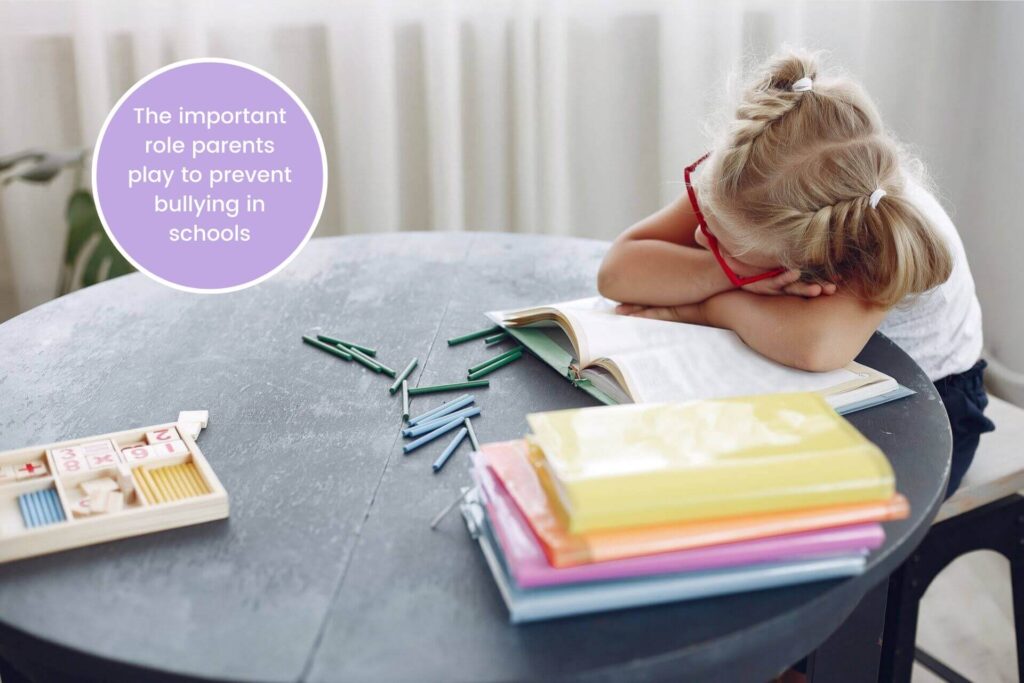
The important role parents play in preventing bullying
As parents, we all have an important role to play in reducing bullying. One of the most powerful ways to start is by learning what bullying really is. From there, we can raise our daughters in a way that helps prevent them from becoming involved in it themselves.
Preventing bullying starts well before school age. From a very young age, children begin learning how to behave by watching us. Parents are their first and most influential role models. Our kids are always observing—listening to what we say, watching how we treat others, and seeing how we handle frustration and conflict.
Our children often also adopt our values, whether we realise it or not. If they hear us speaking negatively about someone, they may begin to feel the same way. The way we speak about others, the way we handle stress, and the way we show empathy all become part of our child’s internal compass.
That’s why it’s so important to take our role as parents seriously. We need to model kindness, respect, and compassion—especially when it’s hard. Our children are learning not just from what we teach them, but from how we live our lives. Let’s be the example they need.
Start teaching values early
By the time children start school they should have a good understanding of how to share, take turns and play cooperatively with others.
But beyond these social basics, there’s one value that stands out as absolutely essential, and that’s empathy.
The power of empathy
Empathy is the ability to understand and share the feelings of another person. It’s what allows a child to notice when someone is hurt or upset, and to care about how that person might be feeling.
Being able to put themselves in someone else’s shoes is a powerful cure to bullying. Children who truly feel empathy are far less likely to intentionally hurt others with their words or actions.
If you notice that your child struggles to show empathy, don’t worry, it’s a skill that can be taught and nurtured. Here are a few simple ways to help:
- Model the behaviour. When a parent shows empathy towards other people, their child will learn from that.
- Meet your child’s emotional needs. A child needs to feel loved and be treated with kindness for that child to be loving and kind themselves. It goes hand in hand.
- Help them identify feelings. Talk to your child about how another child may be feeling. For example, if you’re reading a book together (or watching a movie) and something sad or bad happens to a character, you can ask your child, “How do you think he/she is feeling”? This will help them name the feeling such as sad, lonely, confused, scared, angry or embarrassed.
How to help your daughter handle bullying
A great place to start is by helping her understand that bullying is often about control. It’s usually one child trying to feel powerful by making another feel small.
One of the most effective ways to shift that power is by teaching your child not to react. When a bully doesn’t get the emotional reaction they’re looking for (fear, anger, sadness), their behaviour often loses it’s impact and appeal.
This was exactly the case for my daughter. Once she stopped reacting to her bully, the balance shifted. The bully stopped because the power they once had over her disappeared.
Here are some simple strategies you can teach your daughter if she is being bullied:
- Walk away without reacting. If the bully comes over, stay calm, and just turn and walk away. No reaction equals no reward!
- Stick with friends. Bullies are less likely to target children who are part of a group. Encourage your child to stay close to kids they feel safe with.
- Keep your distance. If someone is repeatedly unkind, teach your child to give themselves space from that person wherever possible.
- Don’t fight back. Hurting the bully back only escalates things. Instead, your child should focus on protecting their own peace.
- You can always talk to me. Let your child know you’re always there to listen, support, and help them through it—no matter what.
- Stand tall and speak up. If the bullying continues, encourage your child to say something simple and strong like, “Go away and leave me alone” or “What you’re doing is not OK.” Bullies often back down when they sense confidence.
- Use humour or indifference. Sometimes a calm, dismissive response like “Whatever,” “Nice try,” or “Are you done yet?” can take the sting out of the moment and show the bully they’re not getting under your child’s skin.
Teach your child not to be a bystander
A child that witnesses their friend being bullied and does nothing about it is called a bystander.
Often, bystanders take no action because they feel scared, intimidated, nervous, and unsure of what to do.
When a child who is being bullied has friends who are bystanders that do nothing to support them, this can make them feel even more alone. It can also make them feel that their bystander friends agree with what the bully is saying or doing
Bystanders play an important role because they have the power to make a positive change. A good friend will recognise that something is wrong, and they’ll intervene, interrupt, speak up, and support their friend to make the situation right.
“Strong people stand up for themselves.
Stronger people stand up for others.”
– Chris Gardner
A friend who stands up to a bully is called an “upstander”. Even having the support of one friend can make a big difference to a young person who is being bullied. When young children are defended by their peers, they become more reassured and are less scared than those who are not supported.
Things that bystanders can do to become upstanders:
- Intervene and stand up to the bully as a group because there is strength in numbers
- Stay close to (and walk with) the child who is being targeted. This will provide a protective barrier between the target and the bully. It will also send a strong message to the bully
- Question the bully about their behaviour. They can say things like, “why are you saying this when it is not true, don’t you have something better to do?”
- They can back up their friend if their friend decides to tell a teacher about the bullying they are receiving
- Let the friend who is being bullied know that they don’t agree with it and that they support them, and care.
Avoid bullying by raising a confident child – so important!
Helping your child feel confident is one of the best protections against bullying. Giving them regular encouragement, positive reinforcement, and emotional support builds self-esteem and resilience. Since bullying is often about seeking power, confident children who know their worth are far less likely to be targeted.
Confidence-Boosting Wall Art
If you would you like a smart and super simple way to help build your daughter’s confidence as she grows – take a look at my confidence-boosting wall art range! By placing positive, empowering, and uplifting words on her wall, those messages are seen every day and over time they strengthen her self-belief and confidence.

For more ‘girl mum’ topics, tips, and free resources, don’t forget to subscribe to Little Girl Shining. You’ll be joining a group of mums with one special thing in common… we all have little girls! x